In this report we present a design for a global network of high seas marine reserves. Marine reserves are highly protected areas that are off limits to all extractive and destructive uses, including fishing. They are the most powerful tool available for the conservation of ocean wildlife and may also benefit fisheries by promoting recovery and reproduction of exploited species.
Summary
The high seas lie beyond the 200 nautical mile limits that define the extent of national sovereignty by countries of the world. They cover 64% of the area of the oceans, and nearly half the surface of the planet. They are a global commons, under the stewardship of the United Nations Law of the Sea for the benefit of all nations.
But human pressures on the high seas are increasing fast, and urgent action is needed to protect them from harm. Recent research shows that industrial fishing has reduced populations of large, predatory fish, like tunas and billfish, by ninety percent or more in the last fifty years.
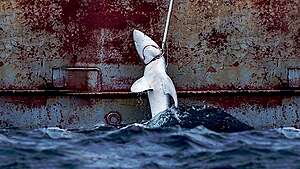
Some particularly vulnerable species, like sharks, have been reduced by factors of a hundred, or even a thousand. In the process of capturing these fish, industrial fishing methods are killing untold numbers of other wildlife, endangering birds, turtles and marine mammals. In the deep sea, heavy bottom trawling gears are destroying seamount habitats that have taken thousands of years to develop and may be irreplaceable on human timescales. Much of this activity is illegal, unregulated or goes unreported.
In this report we present a design for a global network of high seas marine reserves. Marine reserves are highly protected areas that are off limits to all extractive and destructive uses, including fishing. They are the most powerful tool available for the conservation of ocean wildlife and may also benefit fisheries by promoting recovery and reproduction of exploited species. The network we propose aims to protect places that are biologically rich, supporting outstanding concentrations of animals and plants. It also seeks to protect places that are particularly threatened or vulnerable to present or possible future human impacts, like fishing or seabed mining. Our overarching aim is for a network that is representative of the full variety of life in the sea.
To achieve these aims, we brought together many different kinds of biological, physical and oceanographic data. Data on oceanographic features like water temperature gradients and upwelling areas, together with fishery and tracking data on oceanic megafauna, enabled us to identify places that are hotspots of activity on the high seas for large-bodied and vulnerable species. They included tunas and billfish, albatrosses, turtles, pinnipeds (seals and sea lions) and penguins, animal groups whose ranges cover the seas from pole to pole. To this we added maps of cetacean diversity. To ensure that our network is representative, we used data on the distribution of different biogeographic areas, depth zones, seabed sediment types and ocean trenches to represent the variety of habitats and their variation across the globe. We paid particular attention to highly sensitive deepwater habitats, using maps of seamount distribution and bathymetry to identify places vulnerable to harm by bottom fishing. We also used bathymetric data to calculate seabed complexity, which helps in identifying biologically rich places in the deep sea.
All data were mapped using a geographic information system and gridded into 5o latitude by 5o longitude cells, the size of the smallest marine reserves that we considered to be viable in the high seas.