Artificial Intelligence is already an integral part of many areas of life – whether it’s popular applications like ChatGPT or the optimization of industrial processes. But this progress comes at a cost: The infrastructure behind AI consumes vast resources – especially energy, but also water and raw materials such as rare earths.
Summary:
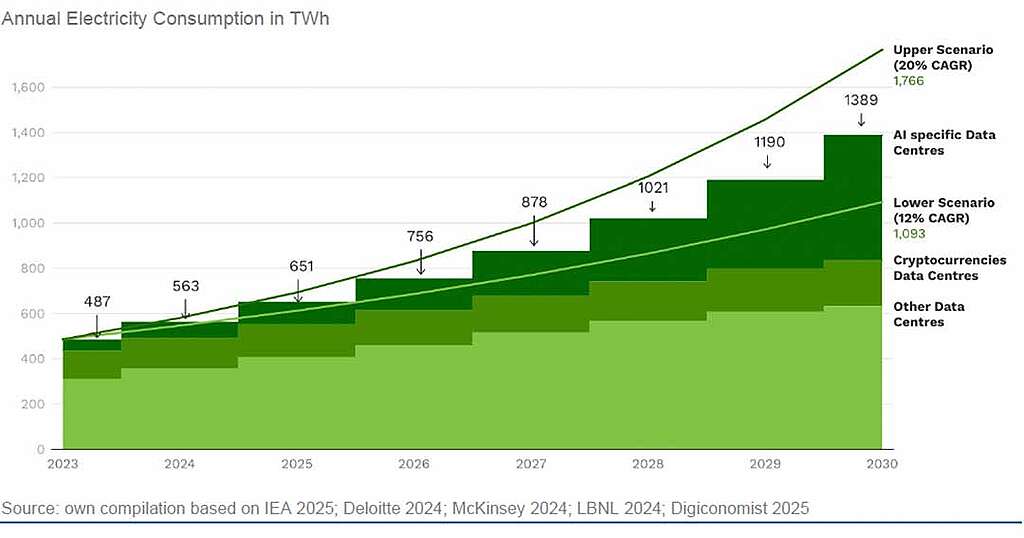
Future Scenario of global data centre (DC) electricity consumption
Artificial Intelligence is already an integral part of many areas of life – whether it’s popular applications like ChatGPT or the optimization of industrial processes. But this progress comes at a cost: The infrastructure behind AI consumes vast resources – especially energy, but also water and raw materials such as rare earths. This report, prepared by the Öko-Institut on behalf of Greenpeace Germany, provides the first comprehensive overview of the environmental impacts of artificial intelligence – and provides guidelines for sustainable AI. The authors evaluated more than 95 studies on the topic, condensing a lot of the available literature in a single report. AI is here to stay – and we must find a way to use it in a climate- and environmentally responsible manner.
The first part of the report outlines the economic trajectory of AI and examines the key players in this rapidly growing sector. Tech giants like Google, Microsoft, Amazon, Apple and Meta are investing billions into expanding their AI-powered product portfolios. This development primarily affects the data centre market: They are building new AI-specific data centres and customised AI hardware on a large scale. Accordingly, the share of specialised AI hardware in the energy consumption of data centres (excluding cryptocurrencies) will grow from an estimated 14% in 2023 to 47% by 2030. The newly built, so-called hyperscale data centres have electrical connection capacities of several hundred megawatts and occupy floor space of up to 4 square kilometres.
The second and most comprehensive section of the report focuses on AI’s environmental impacts – particularly regarding energy consumption, greenhouse gas emissions and water use. Electricity consumption is projected to triple within just seven years. By 2030, the power demand of AI data centers is expected to be eleven times higher than it was in 2023. At that point, AI data centers will require as much electricity as conventional data centers do today. In short, AI is not only energy-intensive in itself – it is a key driver of energy demand in the entire data infrastructure sector. Despite the assumption of a carbon-neutral electricity supply by 2040, CO₂ emissions are projected to rise. Within just five years, AI is expected to dominate overall computing demand. The additional electricity required will prolong the operation of fossil fuel power plants, putting climate targets at risk.
Future Scenario of global data centre (DC) electricity consumption
In Ireland, data centres already account for more than 20% of total national electricity consumption, and in the capital Dublin, almost 80%. Figures between 30% and 40% can be found in cities like Amsterdam, London or Frankfurt/Main. These developments are pushing local grids to their limits, prompting governments – as in Ireland – to introduce regulations on the expansion of new data centres.
AI’s environmental footprint goes beyond energy. Cooling data centres requires large quantities of water – according to the projections made here, data centres worldwide consumed 175 billion litres of water in 2023. Water consumption is forecast to more than triple by 2030 (664 billion litres in total). This is particularly problematic in water-scarce regions. In addition, indirect water use associated with power generation and chip manufacturing further compounds the issue. The production of AI-specific chips is especially water-intensive and is often located in ecologically vulnerable areas. E-Waste is another problem the report addresses: Large quantities of up to 5 million tonnes of additional electronic waste will be generated by the expansion of data centres and AI capacities until 2030.
The report also addresses the increasing reliance on nuclear energy by major tech firms. Google, Amazon/ AWS, Microsoft and Meta are among the signatories of the EU Climate Neutral Data Centre Pact (CNDCP), which commits them to becoming climate neutral by 2030. In an attempt to meet their massive electricity needs while claiming to be “climate neutral,” these companies are investing in nuclear power plants and Small Modular Reactors (SMRs). However, the report warns of the significant and well-established environmental and safety risks of such technologies – including radioactive waste, high water use, and unresolved storage problems.
Beyond these direct impacts, the report explores the systemic and indirect effects of AI – such as rebound effects, where efficiency gains lead to higher overall resource consumption, and increased consumerism through algorithmic recommendation systems. These effects often amplify rather than mitigate environmental pressures. The authors argue that these broader dynamics deserve greater scrutiny in sustainability debates.
To align AI with sustainability goals, the report proposes a five-point framework: AI should only be used when its environmental benefits outweigh its impacts; simpler alternatives should be preferred; lean models must meet real performance needs; efficiency in software, data and hardware use should be continuously improved; and transparency around environmental effects must be ensured. These principles aim to minimise AI’s resource footprint and maximise its contribution to sustainability.
Five-point Framework for AI Sustainability
To align AI with sustainability goals, the report proposes a five-point framework:
- With the increasing use of AI systems in ecologically sensitive AI applications, amendments to environmental legislation should also be considered to establish binding requirements for mitigating AI-specific environmental risks and harnessing technological potential for environmental relief. In other words, specific legal requirements for a ‘sustainability by design’ of AI-based innovations could be defined for ecologically relevant use cases.
- Data access rights for scientific assessments of environmental impacts: The evaluation of the indirect effects of AI applications in particular is complex. Much of the information needed to understand causes and effects of environmental risks of AI is kept secret. In order to understand how the increasing use of such applications affects human behaviour, business processes and the environment, and how AI systems themselves continue to evolve in complex social and ecological contexts, scientists should be given access to data sets and models of ecologically sensitive applications. Access to such data would enable an independent assessment of their ecological impact.
- Data access rights, like other mechanisms for establishing transparency (see above 5.1), can contribute to better information on the existence, causes and extent of environmental risks. Building on the improved information base, ecologically particularly sensitive systems should be subject to stricter risk analyses and reporting obligations. For example, notification systems for AI applications could be considered that require disclosure when AI is used in ecologically sensitive areas. Such a system would enable monitoring and early intervention in high-impact applications through defined thresholds and reporting mechanisms for relevant sectors.
- In addition, data governance obligations for ecologically sensitive AI applications should mandate defining the purposes of data usage and ensuring data completeness and quality during training. Sector specific rules, aligned with the narrower provisions of the EU AI Act, could also help prevent data biases in environmental applications.
- Another reasonable option is an impact assessment framework that provides for the structured and more specific evaluation of AI systems’ environmental effects before deployment. An obligation for companies to implement such an assessment could prevent harmful applications and identify improvement opportunities through methodologies that capture both direct and indirect/systemic effects. For instance, the identification of suitable data centre locations and the approval of construction projects should be based on criteria that take into account the availability of sufficient and timely available electricity, space, water and, where appropriate, heat sinks. Civil society cannot be expected to uncover all planning deficits and deal with the local environmental impacts. Instead, environmental impact assessments should be made mandatory for the planning and commissioning of data centres and new AI sites.
Finally, the report offers concrete policy recommendations. To reduce AI’s environmental footprint, the report calls for clear policy action: mandatory reporting on energy, water and efficiency metrics; efficiency labels for data centres and AI services; better integration with renewable energy and local heating networks; and legal frameworks that go beyond human safety to also address environmental risks. Only with clear regulatory frameworks, international coordination and a sustainability-driven technological agenda can AI contribute to solving environmental challenges – rather than intensifying them.