When it comes to convincing Australia and the world that they’re trying to protect the Great Barrier Reef, the Abbott government is having a hard time.
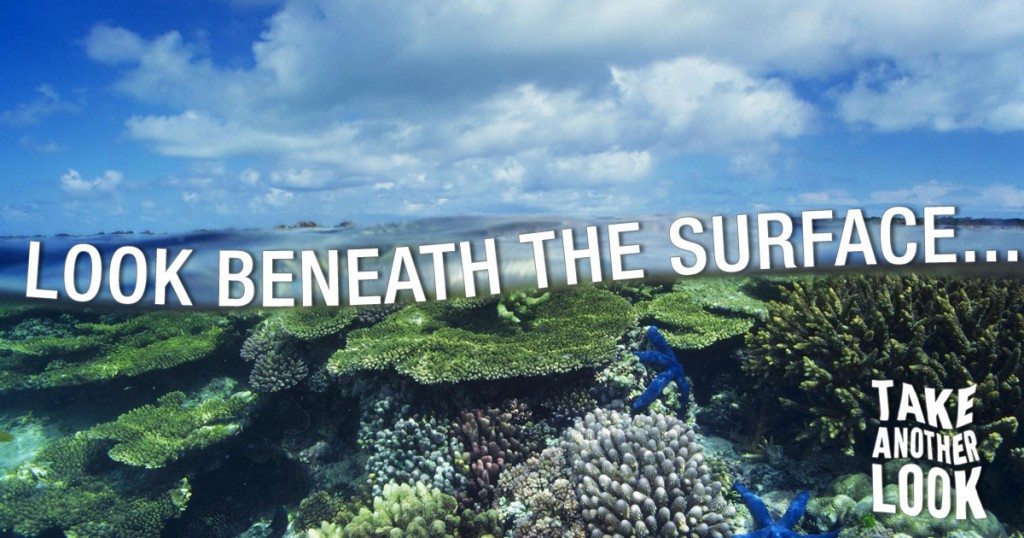
When it comes to convincing Australia and the world that they’re trying to protect the Great Barrier Reef, the Abbott government is having a hard time. We suspect that has something to do with their plans to go ahead with massive coal port and mine expansion in the face of serious threats to the Reef’s health.
In an attempt to win back support, the Abbott government have made claims in relation to their management of the Great Barrier Reef – many of which do not bear up to scrutiny.
Here are six myths we’ve debunked to prove we need to take another look at what we’re being told about the Great Barrier Reef:
Myth #1: The Australian Government has banned dredging in the Great Barrier Reef
Truth: The Queensland Government has said it will prohibit capital dredging outside of existing port areas in the Great Barrier Reef World Heritage Area.
While this ban would mean that capital dredging, which is done to expand shipping waterways, is prohibited outside of existing ports – dredging can still occur in the area where most of the coal port expansions and dredging is currently proposed.
So when Greg Hunt insisted on Australian television that he had banned dredging – he wasn’t quite right.
Myth #2: The Australian Government has canceled port developments on the Reef
Truth: Coal ports on the Reef coast have been met with fierce opposition from local, national and international campaigns and in areas like the Fitzroy Delta, these campaigns have won with the Queensland Government introducing legislation to protect the region.
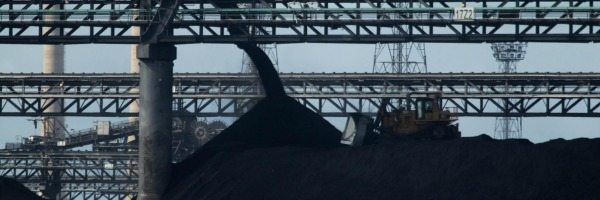
Combined with a falling price of thermal coal, this has meant that many of the port developments on the table a few years ago have become uneconomic, and the proposals have gone on hold.
So it’s people power and a dying coal industry which has stopped these developments, not governmental action.
Myth #3: The Australian Government has stopped dumping dredge spoil on the Great Barrier Reef
Truth: The Australian Government is introducing laws to prevent dumping of dredge spoil from expanding ports in the Great Barrier Reef Marine Park – but this won’t stop all dumping at sea.
They’re relying on the Queensland Government to extend the ban into the World Heritage Area. Unfortunately, both of these measures don’t apply to the dredge spoil that is created to maintain existing channels for ports – this spoil can still be dumped at sea.
!['The problem for coal is that it is the single greatest driver of climate change'.
Originally published in The Guardian
<a href="https://www.greenpeace.org.au/static/planet4-australiapacific-stateless/2024/02/54b75a56-feature.jpg"><img class="alignnone size-full wp-image-7032" src="https://www.greenpeace.org.au/static/planet4-australiapacific-stateless/2024/02/54b75a56-feature.jpg" alt="feature" width="608" height="342" /></a>
<h5> <strong>Photograph: Tim Wimborne/Reuters</strong></h5>
During the second world war, my dad performed his war service down the coal mines in the UK. The work cost him his sense of smell, but gave him a profound sense of camaraderie and regard for the men he served with down in the coal pits. Until the end of his life, my dad was proud of his modest contribution to the peoples’ war against fascism.<!--more-->
Seven decades later and, sadly, coal mining is no longer a noble endeavour. Once upon a time, coal miners justifiably believed they were building Australia’s prosperity. Today, such a belief is no longer credible. The problem for coal is that it is the single greatest driver of climate change. Professor James Hansen <a href="http://energy-reality.org/wp-content/uploads/2013/06/07_Coal-the-Greatest-Threat_R1_032613.pdf">calls</a> coal “the single greatest threat to civilisation and all life on our planet”. The IPCC’s latest report has simply underlined the overwhelming existing scientific and economic case for rapidly shifting away from coal and other fossil fuels.
But like the tobacco industry before it, the coal industry refuses to face its responsibilities, and instead puts all its energies into hitting out. And those efforts are looking increasingly desperate. Yesterday’s bizarre emergence of the Mineral Council’s online <a href="http://www.australiansforcoal.com.au/">"Australians for Coal"</a> platform is just the latest sign of an industry in values freefall. The initiative has proven a lightning rod for social media ridicule: just check out<a href="https://twitter.com/search?q=%23australiansforcoal&src=tyah"> #Australiansforcoal</a> on Twitter. As <a href="http://350.org.au/">350.org</a> put it in one <a href="https://twitter.com/350/status/455869548995284992">tweet</a>: “[w]e love a good corporate hashtag backfire & #australiansforcoal is awesome right now.”
The coal industry is in a state of moral collapse, moving ever further away from public standards of good and responsible behaviour, even as the <a href="http://grist.org/climate-energy/goldman-sachs-says-coal-export-terminals-are-a-bad-investment/">commercial prospects</a> for the commodity are in steep decline. And, without a functioning moral compass, the coal industry has become mired in a sea of ridicule of its own making.
Just last week, Archbishop Desmond Tutu, seen by so many as an icon of hope and moral integrity, called for an apartheid-era style campaign against the whole fossil fuel industry on the grounds of climate change. But it is not only famous figures who <a href="https://theconversation.com/australias-biggest-coal-state-plans-for-life-beyond-coal-24673?utm_medium=email&utm_campaign=Latest+from+The+Conversation+for+8+April+2014&utm_content=Latest+from+The+Conversation+for+8+April+2014+CID_6d78353ab23d4cd5bf44f32d9ca5d942&utm_source=campaign_monitor&utm_term=Australias%20biggest%20coal%20state%20plans%20for%20life%20beyond%20coal">know the game is up</a> for the coal industry. Dramatically, Australians from all walks of life, including <a href="http://www.theguardian.com/commentisfree/2014/apr/01/at-92-i-was-arrested-for-protesting-against-mining-im-glad-i-took-a-stand">war veterans</a>,<a href="http://www.smh.com.au/comment/faith-and-science-combine-as-religious-leaders-join-fight-for-maules-creek-20140312-34m6h.html"> religious leaders</a> and<a href="http://www.theguardian.com/commentisfree/2014/jan/24/this-australia-day-us-underdogs-will-fight-big-coal-to-save-maules-creek"> farmers</a>, are now regularly engaging in civil disobedience against the coal industry because of their deeply held moral concerns.
The collapse of the coal industry’s reputation has been cemented by any number of other unsavoury episodes, from being <a href="http://www.smh.com.au/business/economists-blackened-by-coalmine-20140411-36irb.html">found out</a> giving dodgy economic figures to government; open <a href="http://www.abc.net.au/radionational/programs/lawreport/5380540">conflict with rural communities</a>; the <a href="http://www.theage.com.au/victoria/fire-at-morwell-reignites-browncoal-debate-20140308-34e3n.html">Morwell fire disaster</a>; tipping <a href="http://www.abc.net.au/lateline/content/2013/s3787338.htm">money</a> that was allocated for developing carbon capture and storage into a promotional slush fund; and of course obtaining permission to <a href="http://www.theguardian.com/environment/planet-oz/2014/jan/31/great-barrier-reef-australia-dredging-abbot-point-coal-export">dredge and dump</a> near the Great Barrier Reef in order to build new coal port infrastructure. The list of scandals and outrages associated with the coal industry seems to get longer by the day.
Yet none of this is to have a go at the working people who show up to earn a fair day’s pay at their practical jobs in the coal mining industry. The fault lies at an investor and executive level.
Perhaps the clearest indication of the coal industry’s ethical and moral collapse lies in how it is responding to its own crisis. Instead of facing up to its responsibilities, the coal industry has responded with calls for the draconian use of state force to quell protest. Yesterday Stephen Galilee, the chief executive of the NSW Minerals Council, called for <a href="http://www.theaustralian.com.au/business/opinion/economic-vandals-must-be-jailed/story-e6frg9if-1226882812455#">“heavy fines”</a> and “jail time” for coal protestors. Does he want such penalties applied, to, say <a href="http://www.theguardian.com/commentisfree/2014/apr/01/at-92-i-was-arrested-for-protesting-against-mining-im-glad-i-took-a-stand">Bill Ryan</a>, the 92 year old legally blind Kokoda veteran who is so worried about the impacts of climate change on his grandchildren that he has now been arrested twice protesting at the Maules Creek coal mine?
The coal industry also seems <a href="http://www.abc.net.au/news/2014-04-08/pearson-coal-the-answer-to-energy-poverty/5371462">increasingly intent</a> on claiming that the sector’s real concern is human poverty in developing countries. The most striking example of this corporate Orwellian exercise is Peabody Energy’s slick and expensive "advanced energy for life" campaign, <a href="http://www.huffingtonpost.com/2014/03/27/peabody-burson-marstellar-coal_n_5044962.html">dreamt up</a> by PR giants Burson-Marsteller. The fact that the first and worst impacts of climate change will fall upon the poor and vulnerable within most societies render such claims particularly perverse. In reality, it's hard to imagine that many fossil fuel companies have any interest whatsoever beyond their bottom line.
Which brings us back to the excruciating digital and social media fail of Australians for Coal. In social media, people tend to sniff a lack of authenticity a mile away. Yet the real embarrassment for the coal industry lies in the very establishment of Australians for Coal because any decent industry on a proper ethical footing does not need to try and confect the appearance of public support.
<a href="https://twitter.com/search?q=%23Australiansforcoal">#Australiansforcoal</a> - because when the arrogant, powerful and greedy are challenged by morality, economics and science, they don’t like it.](https://www.greenpeace.org.au/static/planet4-australiapacific-stateless/2024/02/96c30678-gp0sto5qs_press.jpg "#AustraliansForCoal is the latest sign of an industry in values freefall")
Myth #4: The Australian Government is spending $2 billion on the reef
Truth: This money will be spread over 10 years and includes pre-existing commitments from the Queensland and Australian Governments.
A quarter of it – $500 million – is being set aside for safety measures on ships. While safety on ships is important, that money shouldn’t be counted as protecting the Great Barrier Reef.
The Great Barrier Reef supports 60,000 jobs in Australia and brings in $6 billion in revenue every year. We depend on it, so we must do all we can to protect it.
Myth #5: if UNESCO doesn’t list it as ‘in danger’, the Reef is saved
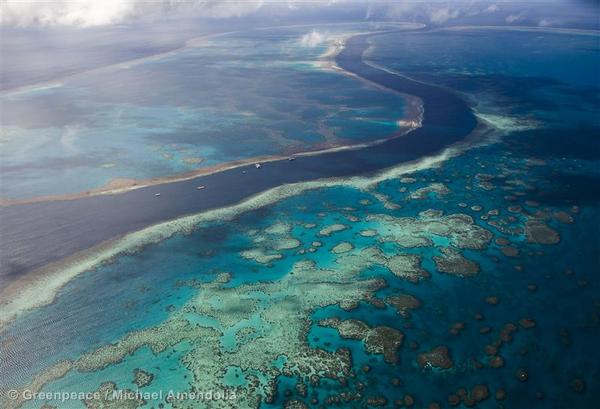
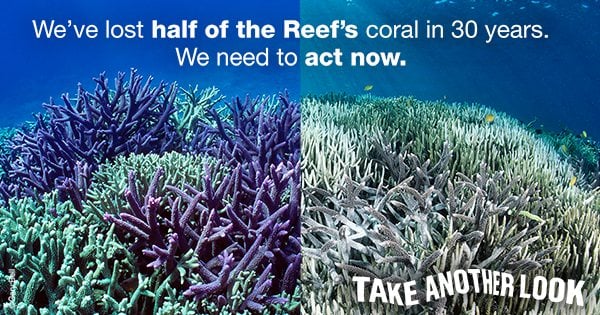
Truth: the reef has lost 50% of its coral cover in the last 30 years and won’t be out of the woods until we address the biggest threat to its future – climate change.
Myth #6: coal is good for humanity
Truth: coal sucks.
The burning of coal is one of the biggest, global contributors to climate change, the greatest environmental threat we face. Mining it destroys ecosystems and burning it also creates air pollution and leads to health problems.
Why do we need to keep our eyes on the Reef?
Greg Hunt and the Abbott government have been trying to get UNESCO to look far away from the Reef. Luckily, UNESCO has made it clear that the Great Barrier Reef is not ‘just fine’, and is deeply concerned with the health of the Reef in their recently released draft recommendations for World Heritage areas.
It’s not over. We need UNESCO to keep their eyes on the Reef. We need the world to know that the Australian government’s ‘Reef 2050 plan’ is not good enough. The Great Barrier Reef is still in danger from a reckless mega-mine and coal port expansion. Don’t look away. Act for the Great Barrier Reef now.