


help protect our forests: submit a letter to the senate inquiry
The parliament is seeking public feedback on reforms to our national nature law. Right now, the Albanese Government is rewriting our national nature law, the EPBC Act. It is a once-in-a-generation chance to protect forests, wildlife and the Great Barrier Reef.
A draft reform to our national nature law has been tabled in parliament which now goes to a Senate Inquiry for review.
As part of the Inquiry the draft reforms are opened to the public for feedback by making a submission.
Politicians need to hear from people like you that you want the broken nature law fixed to halt nature destruction and end the extinction crisis.
Join us in writing to the senate. All you need to do is write from your heart using our guide, or you can copy and paste our pre written letter below.
Submissions are due by December 5th 2025.
This submission is now closed.
Thank you to the 1000+ people who shared their thoughts. We have submitted your responses to the Senate, alongside our own statement.
Together, we are fighting for a strong nature law to protect the animals and places we love.
By signing this petition you give permission for Greenpeace Australia Pacific to contact you with campaign updates. Your information is safe and secure with us – for more information please see our Participant Collection Notice and Privacy Policy.
Did you know...
50 M
animals are killed every year in NSW and QLD, due to deforestation
2 minutes
is the time it takes for an area the size of the MCG to be bulldozed
2.2 M
hectares of forests were bulldozed across Queensland in just five years
Greenpeace is asking corporations operating in Australia to commit to no deforestation or destruction of other natural ecosystems in the key products they produce or sell by the end of 2025 at the latest.
In particular we are asking corporations to prioritise ensuring the beef they produce or buy does not come from cattle operations where forests and natural ecosystems have been recently destroyed (since 2020). This is because beef is the number one driver of deforestation in Australia so tackling this issue quickly will have a big positive impact for our forests.
Well-known corporations such as McDonalds, Woolworths and Coles have a big role to play here so we are asking them to step up and help protect our forests and wildlife by refusing beef produced from deforestation.
Deforestation is the destruction of natural forest, including both never-before bulldozed forest and healthy regenerating or fully regenerated forest.
Greenpeace uses the definition of deforestation set out by a globally-recognised ethical supply chain organisation called the Accountability Framework Initiative. Major global sustainability and climate initiatives such as the Science-Based Targets Initiative also use this same framework.
Importantly, our asks of the Australian government and corporations is to halt both deforestation and the destruction of other non-forest natural ecosystems. The technical term used by the Accountability Framework Initiative to cover destruction of all ecosystem types is "conversion". So really what we are asking for is for no more conversion of natural ecosystems, including no more deforestation of forests. It's just that deforestation is far more understood by the public so we use this term to communicate the problem!
Cattle grazing for beef production is the leading cause of deforestation in Australia as forests and bushland are bulldozed to make way for vast cow paddocks. Around 70% of deforestation in Queensland - the hotspot in Australia - is for beef.
Sheep grazing is another driver, followed by logging to make paper and wood products. Mining, infrastructure and housing development are other drivers. While the local impacts of these developments can be severe, deforestation for beef dwarves all others in terms of the area of forest destroyed annually.
Much of the deforestation occurring in Australia is of regenerating or fully regenerated forest. While a never-before bulldozed forest will always be the best of the best, these recovering forests also have important values. They are slowly bringing back wildlife, stablising soils, and drawing down carbon out of the atmosphere. Allowing the bulldozers to destroy this regeneration kills the animals that have returned and sets back the clock for a long recovery once again.
It must be stressed that many types of forests are unable to recover at all following destruction by bulldozers and replacement with agricultural or other land uses. Where forests are sometimes able to regenerate, such as some Acacia species forests in Queensland, this is no excuse to start or continue bulldozing as the cumulative impacts on wildlife and the land are immense. Restoring any forest to a pre-bulldozed state is also very difficult and can take many decades, sometimes hundreds of years.
Yes, it is possible! We know cattle can be raised in Australia without bulldozing forests and in fact, the majority of beef produced in Australia is already deforestation-free.
But a minority of landholders, mostly in Queensland and New South Wales, are conducting large-scale deforestation for beef production — the majority without any oversight due to legal blindspots in our nature laws which allow areas considered threatened species habitat to be bulldozed.
At the moment, corporations like McDonald’s, Woolworths and Coles do not have adequate systems in place to rule out deforestation from their supply chains, meaning they are effectively hiding the deforestation in their products from consumers. This is not good enough and consumers deserve better.
Over the past decade there has been a wave of global commitments, both from corporations and governments, to eliminate deforestation. Given the growing demand for deforestation-free beef globally, and the deforestation risk associated with sourcing beef in Australia (and especially Queensland), major purchasers must lead the way with strong deforestation-free commitments and robust implementation plans, to ensure that customers in Australia and overseas can be confident they’re not supporting the destruction of our precious wildlife and forests.
Our Aussie farmers need to be fully supported to look after the land and protect and restore forests. This includes through government funds such as Queensland's $500 million Land Restoration Fund and by the big corporations like McDonald's, Woolworths and Coles who can use their vast profits to work with and support farmers to the right thing and pay a fair price for sustainable products.
Really it's the large corporations like McDonald’s, Coles and Woolworths that need to act. They purchase the majority of beef domestically and make millions of dollars in profits and they need to take action to guarantee their products are not contributing to the destruction of Australian forests and wildlife.
Currently this is hidden from consumers, who are unaware that the beef on supermarket shelves or in their Big Mac could be contributing to the deaths of millions of native animals every year. It is imperative that solutions to this crisis are supported by companies linked to, or within, the Australian beef industry who can drive change.
Major purchasers of Australian beef like McDonald's, Woolworths and Coles have a critical role to play in ensuring that their supply chains are not driving the destruction of our forests and threatening our wildlife. Right now, corporations like McDonald’s are hiding this from their customers, most of whom would be shocked to know that their Big Mac is fuelling the deforestation crisis and pushing threatened species like the koala to the brink of extinction. That’s why we’re calling on McDonald’s, as well as major beef purchasers like Coles and Woolies, to lead the way and commit to eliminating deforestation from their products.
This year the Australian government will face a huge test — a once-in-a-generation reform of our national environment law, the Environment Protection and Biodiversity Conservation Act 1999 (EPBC Act). Without strong laws that genuinely protect and restore nature, the destruction of wildlife and forests will continue and countless more native animals will face extinction.
Stronger legislation to safeguard our environment is a win for everyone — so Greenpeace is urging the government to introduce the ambitious reforms needed to protect nature and to ensure a safe, liveable climate for all Australians.
The reforms must address Australia's rampant deforestation, particularly from the beef and logging industries. This will be a key test and Greenpeace and our supporters will be pushing hard to make sure this happens.
The primary driver for Australia’s globally-significant deforestation rates, focussed heavily in Queensland, is bulldozing to make way for pasture for beef cattle. Native forest logging is another key driver, particularly in New South Wales and Tasmania. Half of Australia’s forests have been lost and the continued logging of our native forests endangers species like the Koala, Greater Glider and other threatened species.
Professor David Lindenmayer, Fenner School of Environment and Society, Australian National University said: “All scientific economic and social data show that native forest logging is environmentally, economically and socially bankrupt. We have to make a rapid transition to a plantation-only industry.”
Greenpeace, along with other Australian eNGOs are calling on companies involved in the Australian beef industry to: Eliminate the conversion of all natural ecosystems, including no deforestation, by 31 December 2025, for all beef value chains the company sources from directly or indirectly, with a cut-off date of 31 December 2020.
The cutoff date (2020) is the last point at which there can be any natural destruction in an area for it to be considered deforestation-free into the future.
This commitment is based on guidance from the Accountability Framework initiative (AFi). In line with their guidance, 2020 is the cutoff date meaning the destruction of natural forest or natural ecosystems after the cutoff date renders the affected area, and the commodity produced there, non-compliant with no-deforestation or no-conversion commitments.
The target date (2025) is when companies must have achieved the deforestation-free commitments set out in their policies.
This is the date by which a company (or policy setting entity) intends to have fully achieved or adhered to its commitment of fully removing deforestation from its supply chain.
Tips for making an impactful SUBMISSION
You can use our pre-filled letter option below, or write your own.
Just remember these 3 things:
1. Keep it polite
We're asking the Federal Government to create robust nature protection laws, so that our forests will be safe in the future. They are not the enemy, so ask nicely and please keep it friendly and respectful.
2. Be clear
We need our Environment Minister to know that the future of our local animals and birds is in his hands. He has a once in a generation opportunity to put in place strong protections to save our reef and forests.
3. Spell out risks
If the government doesn't implement strong laws that will protect our wildlife and our forests far into the future, we risk losing the beautiful living world that makes Australia so unique.
SUGGESTed Letter options:
(Simply copy and paste into the submission form above)
Option One: General Letter- Outlining Key Asks
Dear The Senate Inquiry,
I welcome the overhaul of Australia’s broken national nature law, but urge Parliament to strengthen the bill. Australia urgently needs strong laws to halt nature destruction and end the extinction crisis.
The current EPBC Act has been called a “toothless tiger” for its failure to protect wildlife and ecosystems. Reforms must be ambitious enough to stop the rapid decline of our natural places. Without genuine protections and restoration measures, destruction will continue and more native animals will face extinction.
The reformed laws must close deforestation loopholes, deliver stronger safeguards for nature, and ensure effective national implementation. I recommend:
1. Stronger upfront nature protection to guide better decisions on big projects, including National Environmental Standards.
2. An independent Environmental Protection Agency (EPA) to enforce the laws and make decisions about controversial projects at arm’s lengths from politics.
3. Consideration of the climate impacts on nature from coal and gas mines when assessing projects for approvals.
4. Closing deforestation loopholes that allow for harmful industries to carry out mass bulldozing across Australia.
Thank you for your consideration,
Greenpeace (swap out Greenpeace for your name)
Option Two: Priority Issue Letter- Close the Deforestation
Dear The Senate Inquiry,
Massive loopholes in our national nature law allow native forest logging and agricultural deforestation to continue almost unchecked. Australia has one of the worst rates of deforestation in the world, killing tens of millions of native animals each year. Rampant deforestation near the Great Barrier Reef is causing severe soil erosion, washing dirt into rivers and the sea, poisoning the Great Barrier Reef with toxic run-off. We urgently need strong laws that will halt nature destruction and protect our national treasures like the Great Barrier Reef. Substantially reducing deforestation and destruction of other natural ecosystems is therefore the cornerstone of meeting multiple environmental protection objectives.
I recommend the following to achieve a strong, fair, and effective nature law:
Fully regulate the agricultural industry, especially bulldozing of our forests for beef production
The agricultural sector, particularly beef production, is a key driver of deforestation in Australia, and it remains largely unregulated by the EPBC Act through a grandfathering clause from 2000 known as “continuous use”. Without meaningful reform, these sectors will continue to drive massive biodiversity loss.
1. Remove the native forest logging exemption so all industrial logging is covered by federal oversight.
The blanket exemption granted to native forest logging under Regional Forest Agreements allow native forest logging to proceed without federal oversight, even when critical habitats or threatened species are directly affected, leaving entire ecosystems vulnerable to destruction without proper scrutiny.
Thank you for your consideration,
Greenpeace (swap out Greenpeace for your name)
A local problem on a global scale
Australia's deforestation scale is one of the worst.
Australian koalas, parrots, quolls, cockatoos, and countless others are being killed, maimed, or left to starve from deforestation. Their homes are being destroyed by big agricultural companies who are putting their profits over the planet.
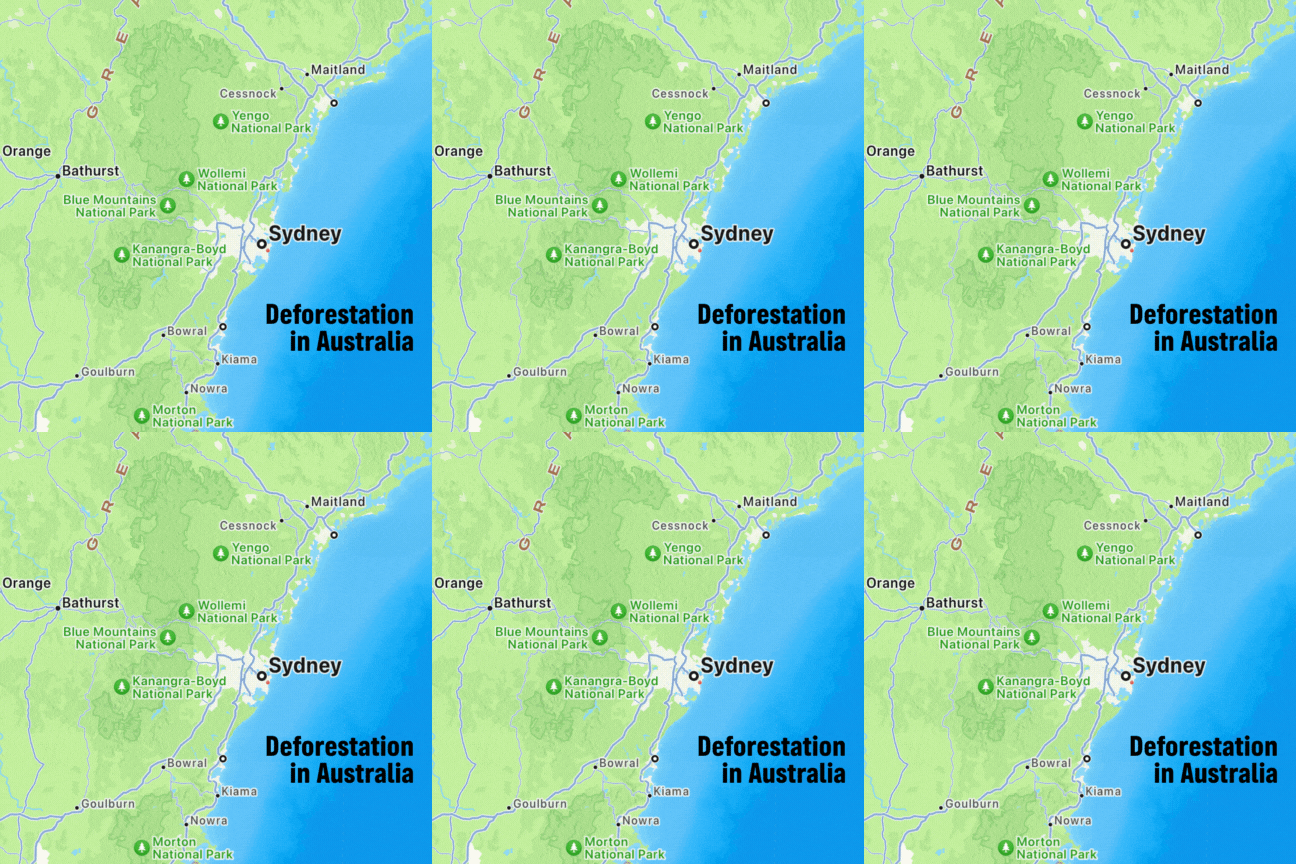
Our investigations have revealed that 2.2 million hectares of forest and bushland was bulldozed in Queensland in just five years. That's deforestation of an area that would stretch from Bondi Beach to Bathurst! Almost all of this land was threatened species habitat.
Tell the Australian Government they must bring in strong laws to protect our unique animals, birds and forests.
Greenpeace is 100% funded by people just like you
Did you know: We don’t take any money from government or corporations, allowing us to stay fiercely independent in our fight for a greener, more peaceful future.